Dec 2018 – Apr 2023
Diagnosis of ARDS in Chest X-Rays
Two experienced radiologists look at the same chest X-ray. One sees ARDS. One doesn't. That's not a hypothetical — agreement on the diagnostic hallmark of this syndrome is only moderate, and in a condition with a mortality rate around 43%, every delayed call matters. In children, it's even harder.
My PhD set out to build a second pair of eyes that always agrees with the evidence — and can show its work.
The arc of the project:
- First, teach the machine where the lungs are. Dense-Unet, a deliberately lightweight segmentation model, learned to outline lung fields in chest X-rays — my most-cited paper.
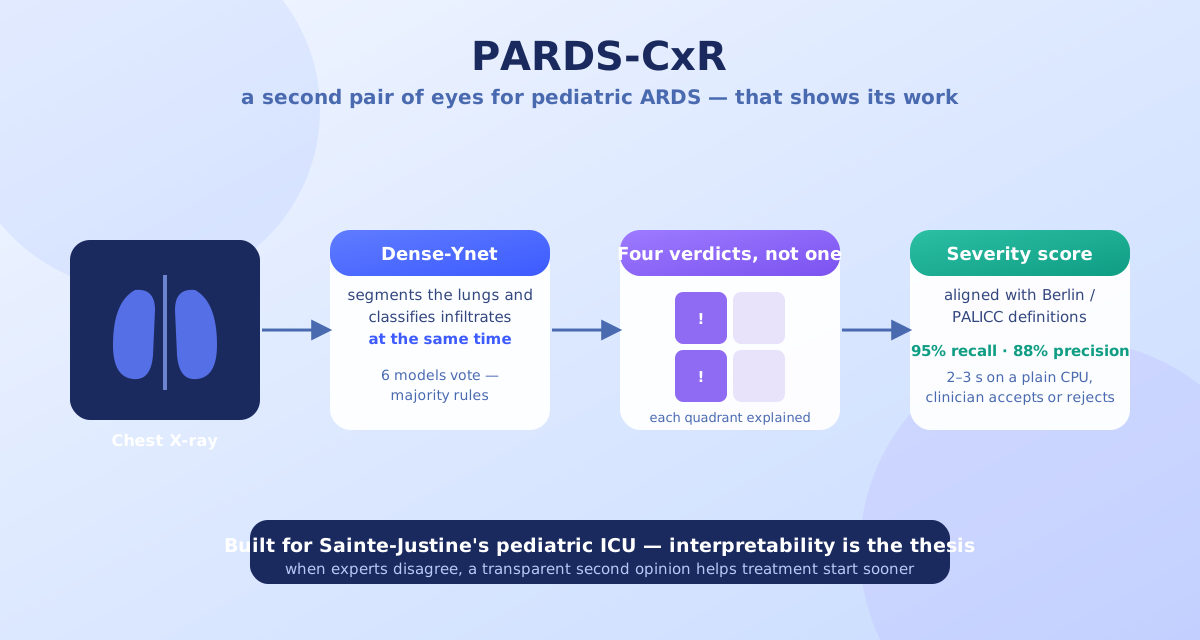
- Then, teach it to look and judge at once. Dense-Ynet does segmentation and classification simultaneously — instead of chaining separate models (where each error feeds the next), it fuses both views, generalizes better, and stays small enough to train on carefully-labeled clinical data rather than noisy internet-scale corpora.
- Make every call explainable. The model doesn't say "ARDS: yes/no." It grades each lung quadrant — four verdicts, not one — so a clinician can see exactly why the system flagged an image, and accept or reject the call. Interpretability isn't a feature here; it's the thesis.
- Turn verdicts into severity. Quadrant patterns map onto a severity score aligned with the clinical definitions doctors already use (Berlin and PALICC), so the output speaks the language of the ICU.
- Vote before deciding. Six independently-trained models vote; the diagnosis stands only if the majority agrees — balancing out individual model biases.
The result — PARDS-CxR: a web platform deployed for Sainte-Justine Hospital's pediatric ICU. It reads an X-ray in 2–3 seconds on an ordinary CPU, works in English and French, handles adult and pediatric definitions, and reaches 95% recall with 88% precision. It's in its beta phase, undergoing the clinical verification a tool must earn before it touches patient care.
This work was supervised by Prof. Farida Cheriet (Polytechnique Montréal) and Dr. Philippe Jouvet (Sainte-Justine), trained on data from multiple hospitals, and published — you can read the platform paper or the full thesis.
Why it matters: when experts disagree, patients wait. A fast, transparent second opinion — one that shows its evidence quadrant by quadrant — helps the right treatment start sooner, for the smallest patients there are.
Skills: Deep Learning · Medical Image Processing · Interpretable AI · Clinical Deployment